
The Untapped Potential of Devastating Silence
(written the morning of All in 2026)
Overcast and grey with a fog horn piercing the veil of early morning silence, a familiar sight for most who’ve spent more than a day in the Pacific Northwest, Pete Martell left that morning to go fishing. Very little seemed out of the ordinary until he found a body wrapped in plastic on the shore. Laying amongst the rocks, shells, and various other discarded victims of David Lynch’s impulses, what was left of Laura Palmer finding her own satisfaction and agency, even in death, shattered the illusions of Twin Peaks being an idyllic, peaceful place. Attention gets brought upon the small town (was supposed to be 5120, which makes way more sense than 51,201, but that’s a different column) as Special Agent Dale Cooper uncovers the duality of existence in Twin Peaks, complicating the worldview of those who never would’ve thought otherwise.
Laura Palmer was the prom queen, the beautiful blonde girl in the photograph, and despite everyone silently knowing she was in trouble, it isn’t until Bobby Briggs calls them out at her funeral that they can no longer return to their sense of comfort in what they chose to believe was their uncomplicated, uninterrupted, unchallenged simple lives. It took a shocking discovery like a beloved hometown character being found, lifeless and blue on the shores of the Pacific Northwest to disrupt the status quo permanently, and life in Twin Peaks would never be the same for anyone who lived to see it.
Would the opening scene of Twin Peaks have been nearly as impactful and atmospheric without its long shots, minimalist score, and limited dialogue? Possibly, it is David Lynch after all, but not likely. Sometimes, the most devastating, memorable impact derives from moments of intentional diegetic silence.
Most people in attendance at WrestleDream 2024, myself included, were pretty certain that they were witnessing the last match of Bryan Danielson’s career, at least as a full-time wrestler. Despite the cavernous Tacoma Dome spreading out the thousands in attendance more than they normally would be at any typical arena, there was a shared sense of unity in knowing what was about to happen.
However, sometimes even an expected outcome can create a shocking surprise in its method, if not its story.. Fire Walk With Me, and in even more explicit detail, Laura Palmer’s diary, revealed the stark contrast between what most citizens of Twin Peaks perceived and what was actually going on. Depravity, danger, and tantalizing desires unbecoming of those supposedly living the ideal existence cast Laura in a much different light than many were willing to acknowledge and articulate. Bryan Danielson, despite being once the leader of the YES! Movement where he advocated for his own opportunity against the Authority, likely would’ve been satisfied by wrestling a retirement match in the town hall of a place like Twin Peaks, as it’s much closer to the atmosphere of Aberdeen, Washington in which he was raised, but Tony Khan just had to insist he did silly things like winning a championship in front of 50,000 people to one of the greatest pops in AEW history.
Anyone who read Danielson’s autobiography is keenly aware of how the perceived lack of ambition emanating from him isn’t an act and nearly cost him many career opportunities to be in the spotlight of professional wrestling, and other than that whole “eating enough food to survive” thing, he really didn’t seem to mind too much as long as he was doing what he loved. Additionally, he’d been known to be a bit of a sicko, a term which adapts readily to whichever context it’s used in the land of Elite, and despite his zen-like acceptance of the inevitable, the ere month’s post-championship match moment startled even the sicko-est of the sickos.
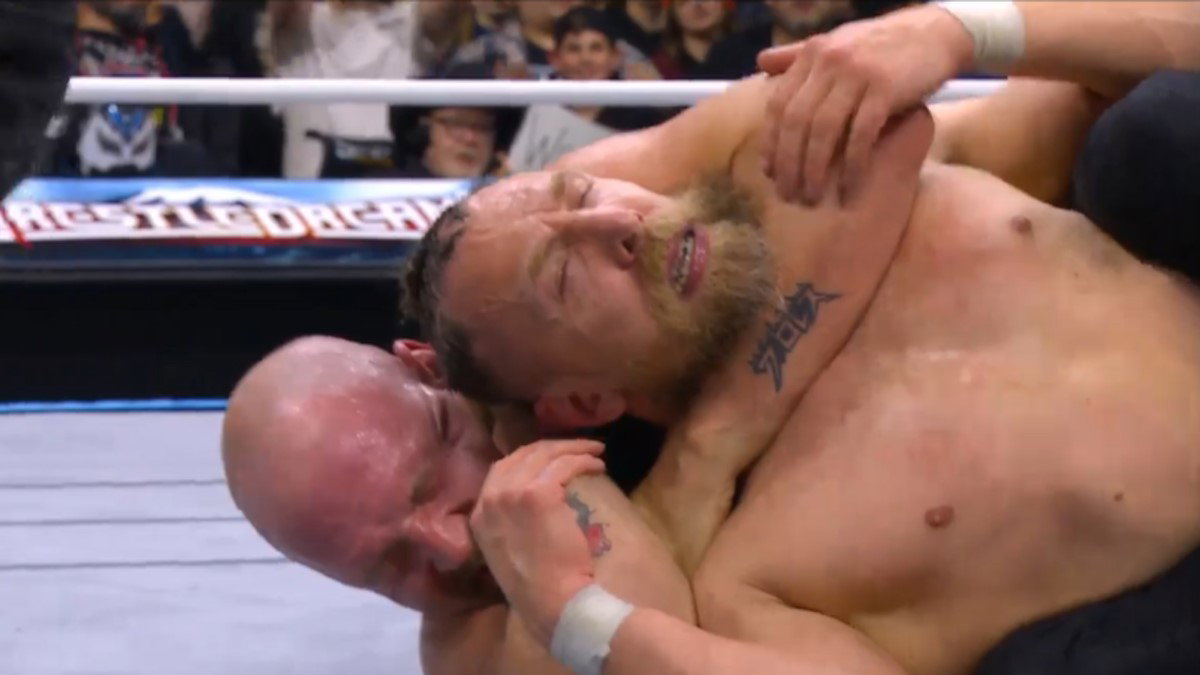
As Danielson celebrated retaining his championship at All Out, his super fun league of best wrestling buddies and white t-shirt fetishists were gathered around, and only Wheeler Yuta was about to be the Pete Martell of the situation that unfolded (until he wasn’t, for some reason). With a sudden uppercut, Claudio Castagnoli struck down the American Dragon, and Danielson’s big surprised face was only a prelude to what was about to ensue as Pac held back the flailing arms of Yuta. A plastic bag was wrapped around the face of the AEW World Champion, suffocating him into unconsciousness, and setting up his opponent for his hometown title defense at WrestleDream.
The Blackpool Combat Club was no more. Where once the Ricky Vaughn treatment accompanied Jon Moxley’s crowd entrance, now a much slower, more threatening entrance theme scored the arrival of the leader of the Death Riders, along with the most intimidating member of the faction (unless she’s actually in a match, for some reason) Marina Shafir. The stage was set, and even though nobody in the Tacoma Dome that night thought they’d be seeing Danielson retain the AEW World Championship, very few could’ve guessed exactly how said finality would transpire.
Bryan Danielson had overcome one retirement already, and since arriving in All Elite Wrestling, he’d put on some of the best matches in the company’s history, seemingly treating AEW shows as an opportunity to have ridiculously good matches for the sake of them as well as sell neck injuries, seizures, a shoot broken arm when it’s needed for a submission hold, and fighting a man for an hour who admitted to letting a girl take the fall for a high school car accident, as you do. Wrestling is weird. But, with the inevitability of the proper time, opponent, and location for a grand finale, everyone thought Danielson would go out on his shield, but that he would not go gentle into that good night. That wasn’t the Bryan Danielson fans across companies and generations fell in love with, why wouldn’t the conclusion of an unexpected second run of his career be achieved in grand fashion? Maybe with a heartfelt speech afterward, akin to the first flannel-clad, tear-soaked announcement many years earlier?
Instead, in startlingly anti-climactic fashion, Danielson passed out in a chokehold. The bell rang as a stunned Tacoma Dome crowd couldn’t believe Danielson’s career went out with barely more than a whimper. That was it? That was what the end of Bryan Danielson, the American Dragon, the YES!-Man? Then, not to be outdone, Wheeler Yuta exchanged babyface fire and crowd chants for putting the final exclamation point on Bryan Danielson’s career with the plastic bag treatment, and maybe pilfering a move or two in the process. I mean, hey, it’s there, it’s not gonna be used anymore, might as well pick it up after he dropped it.
Despite an entire locker room of professional wrestlers, many of whom were at least mildly fond of Danielson, so much of this devastation was allowed to transpire uninterrupted, save for fellow hometown star Darby Allin, and Jeff Jarrett of all people also failing to delay the inevitable. Finally, the face locker room emptied so late that even Walder Frey would’ve been annoyed, and the camera shots held long on wrestlers like Orange Cassidy, Daniel Garcia, Darby Allin, implying that they would be the ones to seek revenge. All the while, the Tacoma Dome remained in abject silence at what they’d just witnessed as WrestleDream went off the air.
I cannot properly articulate just how much that devastating silence stuck with me. I truly thought it was the beginning of an epic, sprawling storyline that would see many different wrestlers attempt and nearly succeed to conquer the Death Riders, only to realize they needed to unify and fight together in order to finally topple the plastic bag cult in dramatic fashion appropriate to the way in which the story began. Because of the atmosphere created, and the collective (lack of) sound of thousands of people being utterly stunned at the result of a match that they knew was inevitable, I gave the Death Riders story so much rope that they could’ve all Danielson’d themselves with it several times over.
Twin Peaks is one of the most influential, creative, atmospheric, and unique shows ever created for American television. The first season is a masterpiece. The second season? Well, it sure did exist. With David Lynch’s presence and mind elsewhere, other people stepping in took the show to a place that made it unrecognizable from the potential created by the pilot episode. The revival has mixed reviews, and even with a lot of retconning and supplemental reading material providing some forms of clarity to the overall mystique of the world, the show itself never quite achieved the heights that the first episode, and perhaps even the first scene, indicated that it could. And I say this as someone who absolutely adores Twin Peaks, as good as it was (at times, at least), it never truly lived up to the first 90ish minutes of brilliance in its debut.
The first shows after the Death Riders dispatched of Bryan Danielson seemed to be building off that moment. The underground cinematic style that the Death Riders promo was shot, incorporating Danielson being stretchered off, was a stark contrast to any other visual form preceding it. The way the lower card roster members waited at the entrance area, preparing to confront the Death Riders upon arrival, also started forth the story of how it could build from the ground up to the collective effort it would take to finally bring the Death Riders down after no individuals or separate group of folx could manage to do so. The potential of that silence in the Tacoma Dome, the visuals of the next generation of main-eventers all realizing they were in for the fight of their lives, it laid the foundation for an epic saga that could culminate nearly a year later at All In Texas.
The first groups to step up indicated that those who joined the good fight would escalate until it either reached a group of main events banding together, or perhaps an alliance from different places in the card were able to overcome the team of assassins trying to scorch the earth and rebuild on the ashes. Top Flight and the Dark Order made valiant attempts, but were ultimately crushed. Alex Reynolds pleaded for the Young Bucks to get involved as they stared vacantly at the destruction. Even Nigel McGuinness, years-long rival of Bryan Danielson, was offended and near-confrontational with Wheeler Yuta in particular, showing an interview where the tension was thick and hinted at potential involvement.
A year later, at All In Texas, The Opps were the trios champions, defeating the Death Riders with a huge pop after Willow, Swerve, and other allies balanced out the shiftiness. Will Ospreay and Swerve Strickland banded together for an epic half-hour tag team match. Hangman Adam Page won in the main event, after Will Ospreay and Swerve got involved, Darby came down from the rafters, and Bryan Danielson finally returned to seek his revenge. Perfect ending to the story, right?
Not so much.
Will and Swerve teamed together (in again, one of the best matches in AEW history) to defeat… the Young Bucks? Okay…
Orange Cassidy was… nowhere to be found in the storyline after an initial attempt to win the championship from Moxley.
Daniel Garcia was… somewhere. I don’t think he joined the Death Riders until after All In Texas, but the fact that I can’t even remember says a lot about how his participation in the angle worked out.
Darby was set up to be the one who inevitably brought Mox down, but he went mountain-climbing just at the point where he should’ve been starting his redemption.
Nigel was… on commentary.
The collective effort of the locker room to unite? Disappeared after a couple weeks.
The union (no 2x4s) of folx standing up to the Death Riders was set in a title match with Mox where they had to fight against each other and for the championship. It didn’t work.
Oh yeah, and the championship belt itself was hidden away after being obtained. At All In Texas, it was finally unveiled once again when Hangman won the main event. The reason the Death Riders hid it away? What was achieved by finally retrieving it? What was the point of any of that? It sure did happen.
In between the initial weeks of the storyline and its conclusion, we had… Adam Copeland and/or Rated FTR for a hot minute. Swerve lost a title match via shenanigans. So did many other folx. The message the Death Riders were sending out was crystal clear since day one, and that was… well, it sure was a message, that’s for sure.
I’m as aware as anyone that sometimes wrestling fans can fall into the trap of fantasy booking and then being upset that it didn’t live up to the storylines and/or matches they invented in their own head, and I’m trying very hard not to write this in that vein. All In 2026 will be starting imminently as I write this, and as I sit in a hotel room near Tacoma, mere miles from the place where I sat in that devastating silence of the end of Bryan Danielson’s career, I’m thinking about what could’ve been, both in my personal life for reasons I won’t get into, and in the follow-up to that great story they never told, even if the ending turned out pretty alright for what it was. That silence in that building was so potent, so startling, so utterly devastating, that the long story that was set up to transpire should’ve been told, and because of how much it stuck with me, even nearly two years later, I can’t help but be disappointed that the lightning in the bottle was never captured the way I think it could’ve and should’ve been.
But hey, at least the second attempt at a long-form story with the Death Riders rebuilding Will Ospreay from the ground up is about to pay off today with…
Oh, Nigel is facing Mox though? That’s cool, I suppose.
Laura Palmer’s ghost and the foundation of a story that ultimately never came to be told are two of the moments in media that, while I still voraciously enjoy the overall products that came to be, will always remain in my head as two moments of devastating silence whose true potential will always remain without their full potential ever being utilized afterward.
I’m sure All In 2026 will be great regardless, though.