
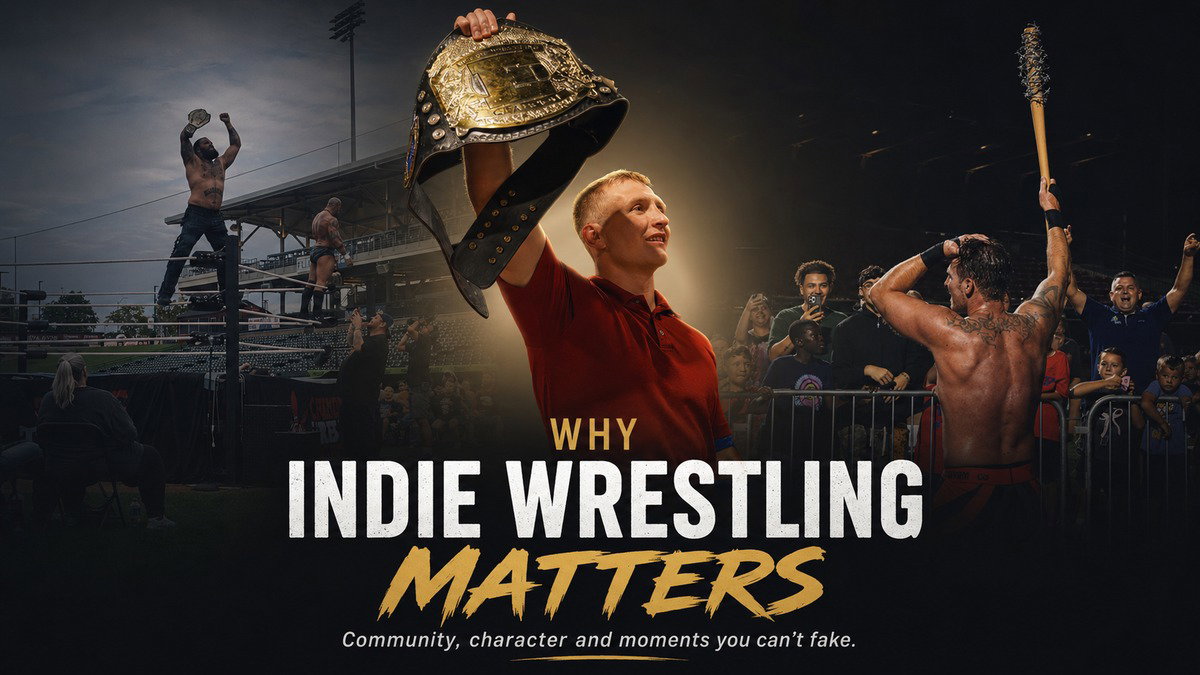
Professional wrestling is often discussed as if it begins when the television cameras turn on. Championships become important when they are defended on a national broadcast. Wrestlers become worth knowing when they sign with WWE, AEW or TNA. A crowd becomes meaningful when attendance is large enough to become part of a press release. That way of looking at wrestling ignores much of what makes the industry work.
Independent wrestling matters because it is where professional wrestling remains closest to the people who create it, support it and allow it to survive.
Over the past several months, I have spent more time covering independent wrestling events throughout Indiana. I have watched wrestling inside fairground buildings, event centers and baseball stadiums. I have seen audiences of different sizes, promotions with different resources and wrestlers at dramatically different stages of their careers. What I have not seen is wrestling that feels insignificant simply because it is not being broadcast nationally.
At EMERGE 98: Back In The Saddle, fans frequently recognized who was about to appear before an entrance had fully developed. The music would begin, the reaction would build and the audience immediately understood the relationships between the wrestlers involved. That familiarity did not come from a national television package explaining who mattered. It came from months and years of wrestlers repeatedly appearing in front of the same community and earning a response directly.
At Grand Slam 2, professional wrestling occupied a baseball stadium in Kokomo. Elijah Eros captured the Grand Slam Championship, Chris Owens fought through a No Disqualification main event and an audience gathered around something created specifically for that city.
At Swinging for the Fences 2 in South Bend, the crowd’s connection with Tyler Matthews (Spotlight coming soon) made his championship defense feel important before the opening bell. The response was not manufactured by a marketing campaign telling the audience that Matthews was a hometown figure. The people in the building already knew what he represented to them.
That connection is one of independent wrestling’s greatest strengths.
National promotions can use television time, video packages, commentary and months of production to establish a performer. Independent wrestlers frequently have only an entrance, a few minutes in the ring and their own ability to make an audience care.
They learn quickly whether their presentation works. They hear when a crowd reacts, when it loses interest and when something unexpectedly connects. There is less distance between the performer and the response. The audience is not simply consuming a finished product. It is participating in the development of the people in front of it. Independent wrestling is often described as a proving ground for wrestlers hoping to reach a larger company. It certainly performs that function, but reducing the entire scene to a developmental system is dismissive. Not every meaningful wrestling career must conclude with a national contract.
Some wrestlers build long careers traveling between regional promotions. Some become champions in front of audiences that have watched them develop for years. Some train the next generation. Some become dependable veterans capable of helping inexperienced wrestlers improve. Some create characters and stories that matter deeply to hundreds of people, even if millions never learn their names. That work still matters.
The independent scene also contains stories that cannot be understood by reading a match graphic.
A results listing can tell readers whether Teagan Thorne won or lost. It cannot explain that she was pronounced dead following a childhood car crash, survived an extensive recovery and eventually transformed part of that experience into the foundation of her wrestling identity. A championship listing can tell readers who currently holds a title. It cannot explain what carrying that championship means to the wrestler, what sacrifices led to the opportunity or why a particular audience has embraced that person. Those stories exist whether a major promotion notices them or not. The difference is whether someone takes the time to document them.
Independent wrestling also matters because it remains capable of functioning as a community institution. Headlocks for Henry was not important simply because wrestlers competed inside a ring. The event brought wrestlers, businesses, sponsors, organizers and fans together to support Henry Emily and his family during his fight against cancer. The event raised more than $10,000 and approached $11,000, but its value was not limited to the final total. It also gave a child and his family an evening where professional wrestling could provide excitement and temporary relief from a situation considerably more serious than anything happening inside the ring.
EMERGE Wrestling’s Stock The Shelves applies the same principle differently, using a wrestling event to collect nonperishable food for the Love Chapel Food Pantry.
These events demonstrate what can happen when a promotion understands that community support cannot be a one-way transaction. Fans buy tickets, purchase merchandise, share announcements and return month after month. Promotions that use part of that relationship to support local families, charitable organizations and community needs create something more durable than another wrestling card.
None of this means independent wrestling should be protected from criticism. Cards change. Communication can be inconsistent. Production values vary. Some events are poorly organized. Some matches do not connect. Attendance claims, championship histories and promotional announcements still require verification. I have been lucky enough to not have experienced any of these things yet, but I’m not naive enough to think they don’t exist. My goal is to call it like it is. Taking independent wrestling seriously does not mean pretending every show is exceptional. In fact, serious coverage requires the opposite. It requires accurate names, confirmed results, properly attributed quotes, clear corrections and an understanding that a journalist is not simply another member of a promotion’s marketing department. But polish and importance are not the same thing.
A show can have modest lighting and still produce a remarkable match. A wrestler can have limited social-media reach and still possess a story worth telling. Kellin Craven announced during a match that he was a special needs parateacher; in the match! That’s where I came up with the Spotlight on him, not to mention he was a highlight reel in his own right. A promotion can operate outside the national conversation and still create something meaningful for its audience and community.
This is also why independent wrestling journalism matters. Social-media posts disappear beneath newer announcements. Results become difficult to locate. Promotions close, wrestlers change names and videos are removed. Without consistent reporting, substantial portions of regional wrestling history exist only in memories and Facebook timelines. A published interview creates a record of who someone was at that point in a career. A results article preserves what happened at a particular event. A follow-up explains why the result mattered. Internal links gradually turn separate shows and interviews into a documented history of a promotion, wrestler or region. That record becomes even more valuable when someone eventually does reach national television.
By then, the earlier work can show where that person developed, what they believed before wider recognition arrived and which audiences supported them when their name was not yet familiar.
Fans who primarily watch national wrestling do not need to abandon it to appreciate the independent scene. They only need to recognize that television represents one part of a much larger industry. The next wrestler who captures a national audience may currently be performing in a fairgrounds building. The next important trainer may never appear on television. The most meaningful result of a show may be the amount of food collected or money raised rather than who had their hand lifted.
Independent wrestling matters because it creates opportunities, builds local traditions, tests performers, connects fans directly with wrestlers and gives communities something that belongs to them. It matters because the people involved care enough to construct rings, travel for hours, promote events, learn names, announce matches, take photographs, sell tickets and perform for whoever arrives. Most importantly, it matters because professional wrestling has always been more than television.
At its best, wrestling is a room full of people deciding together that what happens next is worth caring about. Independent wrestling is where that feeling is often easiest to find.

