
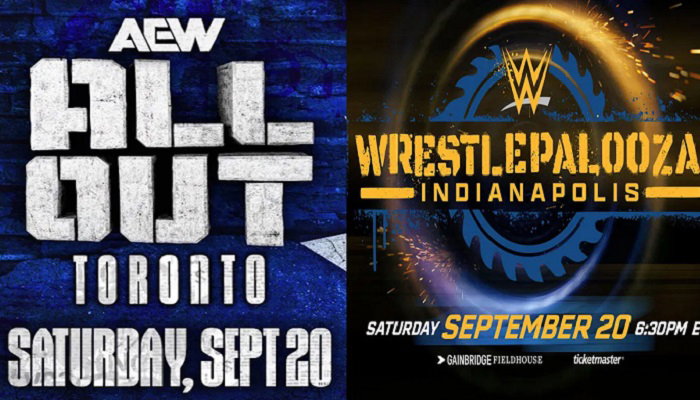
WWE and AEW are both running shows today in the former’s latest counterprogramming effort. Let’s call it what it is since All Out had been locked in for today and at its original timeslot for quite a while.
Let’s also be honest. Despite this clearly being what it is — as transparent as it is — it’s also not a big deal in the grand scheme of wrestling history. It’s far more common than not.
If we look outside the WWE monopoly era, you can look at WrestleMania 4 vs. Clash of Champions in 1988. Raw vs. Nitro in the 1990s. Dynamite vs. NXT were head-to-head a few years ago. These shows all share that commonality, and they’ve all meant different things in the context of those eras. Vince McMahon’s cementing of his supremacy in the 1980s left other companies either in shambles or near their breaking point. That includes the NWA and what later formally became known as WCW.
The two promotions that would later define wrestling in the 1990s were constantly raising the stakes opposite the other. For example, when Jim Crockett announced he was going to run the 1987 edition of Starrcade live on pay-per-view on U.S. Thanksgiving Day, McMahon took great personal offense to this transgression and set Survivor Series for the same day. As the story goes, Crockett feared what a direct head-to-head PPV brawl would do to them financially and he switched Starrcade’s start time. There were some other alleged threats from McMahon to providers about airing the PPV, but that’s less important.
This continued on through the winter with McMahon airing the first Royal Rumble live on free TV against Crockett’s Bunkhouse Stampede. That was followed by the aforementioned scheduling of Clash of Champions against WrestleMania 4. These early interactions set the groundwork for what was going to come during the Monday Night Wars where counter-programming and underhanded Bischoffian (we coin new terms in these parts) tactics became the norm with WWF on the ropes and nearly out for good. Despite WCW dominating McMahon for over a year and a half, eventually that waned. By the time we entered the 21st century WCW was in shambles too. McMahon was all-too-ready to kick his competition when it was down, and for their part WCW did not do itself any favours.
Once the companies’ rivalry ended, we didn’t see anything that volatile in the wrestling space until AEW was formed in 2019. Although TNA briefly thought they could match WWE on Mondays, that time gap played a definite role in the perspective some may have formed since 2019 that WWE is merely trying to keep the fledgling company down and in its place whenever it counters the other’s shows. Yet, just looking at the dynamics of WWF and NWA/WCW, it’s clear this has always been the case. And that’s only one example among many other promotions. It’s further clearer the roles are as they were in the 1980s with AEW and Jim Crockett Promotions trying to fill the same void while offering an alternative to WWF/WWE’s dominant market share.
Simply put wrestling companies have always been trying to outdo the other. Arguably Paul Heyman did the most with the least with ECW. The point especially feels true when you have a wealthy entity with the platform to make considerable noise, and regardless of whatever posture the big dog in the game holds, actions speak louder than they’d like to think. A quacking duck is probably a duck, and if it seems like WWE is trying to pin AEW down that’s because it is. In the same vein, AEW will unabashedly always be punching up at TKO and WWE where it sees fit; that’s the way it should be until one gives ground to the other in either direction.
It’s pure gamesmanship with a sprinkling of egoism.
This is all to say the dual scheduling of AEW and WWE’s weekend shows today is not as big a deal as some make it out to be. Conversely, it’s also very transparent despite what the official stance from WWE, TKO and ESPN happens to be. Twice in several months WWE has counter-programmed two major AEW shows — All In and All Out — presumably in an effort to stifle AEW’s momentum. There’s not much you can say to argue that point. In both instances AEW had their schedule set first, with Wrestlepalooza being set for their ESPN debut at the same time All Out would have otherwise started.
This is what happens when two rival companies exist in the same sphere. Inevitably they are going to clash, they will snipe at each other, and they will puff their chests out and boast even when it isn’t warranted. The Wrestlepalooza scheduling is as deliberate as Tony Khan moving All Out ahead four hours to 3 p.m. No matter the spin, the WWE-TKO-ESPN axis wanted to set a show for this Saturday, and AEW moved its show both to give fans some breathing space and to ensure the shows can stand on their own without eating into the other’s platform (more so AEW here, obviously).
The point is this is the natural order of a wrestling cross-company rivalry where you have the top company and a challenger brand jockeying for the same portions of a pie. Their interests are at odds, their desires do not align and more often than not one will try to outdo the other. It’s very transparent business practice. For example, down the street from me there’s a pet store that has been there for 20-odd years. Last summer a new store opened up right across the street, offering the same products and better services. The time and place are no coincidence, and the same is true in wrestling.
There are parallels between the two eras and frankly counter-programming has been the rule more than the exception. So if this is the norm and the companies are going to commonly act like weird little children while the wrestlers mostly want to sing campfire songs together, what do we do as the viewing audience on days like today? Simply put: shut up and watch wrestling. Critique it honestly, but enjoy the shows. Whether they stayed head to head at 7 p.m. ET or if they’re back-to-back as they are now, enjoy them. Choose to watch both, one over the other, or neither. Watch an indie show on Triller, or go watch a local promotion.
While the corporate idiots will continue being corporate idiots, we don’t have to follow suit here. We get to choose what we watch and why, and I’d like to think everyone can be mature about it. Yes, WWE is trying to pin the “little guy” down — the little, billionaire guy, but I digress — and yes, AEW is going to shit-talk because they’re the equivalent of a small dog to a larger one. What would you otherwise expect when one is the status quo, and the other is the new kid with their own vision of how to operate?
This is what competition looks like in wrestling. It’s an argument I’ve made numerous times, and it’s typically where we see the best of what the companies are capable of. It also creates potential nexus points where tides can shift where either WWE continues to expand, or maybe AEW expands where WWE seems to neglect specific markets. For example, the domestic backlash to WWE announcing Saudi Arabia as a destination for WrestleMania is real. The recent comments that were made about WWE ticket prices becoming less family friendly by TKO COO Mark Shaprio are all real.
Shapiro specifically said:
“WWE is not where the UFC yet is on ticket yield… Vince McMahon was primarily pricing tickets for families and wasn’t totally focused on maxing the opportunity.”
If that’s the aim and we should expect UFC-level ticket prices for WWE in the near future, pricing out the common person from watching a live event also becomes a vivid reality. That’s where counter-programming tactics like Wrestlepalooza vs. All Out can turn around and be counter-productive. Sure it’s not like they’re competing in the same towns, but who’s to say that does not trickle down into subscriptions, extra fees or straight-up price increases. It is very expensive to subscribe for WWE content now, never mind the costs of going to live shows. That creates opportunity for competitors, especially in a case where that competition might offer more of what you like than not in a wrestling show.
For his part, Tony Khan has come out and opportunistically said AEW’s tickets will stay family friendly. That’s notwithstanding being less accessible from a violence perspective, and there’s a built-in joke about their ticket prices and crowd sizes. Regardless of that, it’s something he acknowledges as a reality of their role in the landscape. Further to that, if WWE is going to hold WrestleMania outside North America, Khan was asked about running a major show in the U.S. against WrestleMania. During the All Out media call he said the following:
“I have a lot of interest in it. I can promise we’re going to run a huge event in the spring of 2027. I think spring 2027 is going to be a great time for AEW.”
This is pure gamesmanship and opportunism, and that’s the point. These companies generally have always tried outdo the other, always counter what they’re doing, and have always be unafraid to capitalize on opportunities when they’re presented. Whether Tony Khan does run a 2027 show directly opposite WrestleMania in North America remains to be seen. But the prospect of that should be taken seriously as WWE becomes more corporatized and less focused on accessibility.